
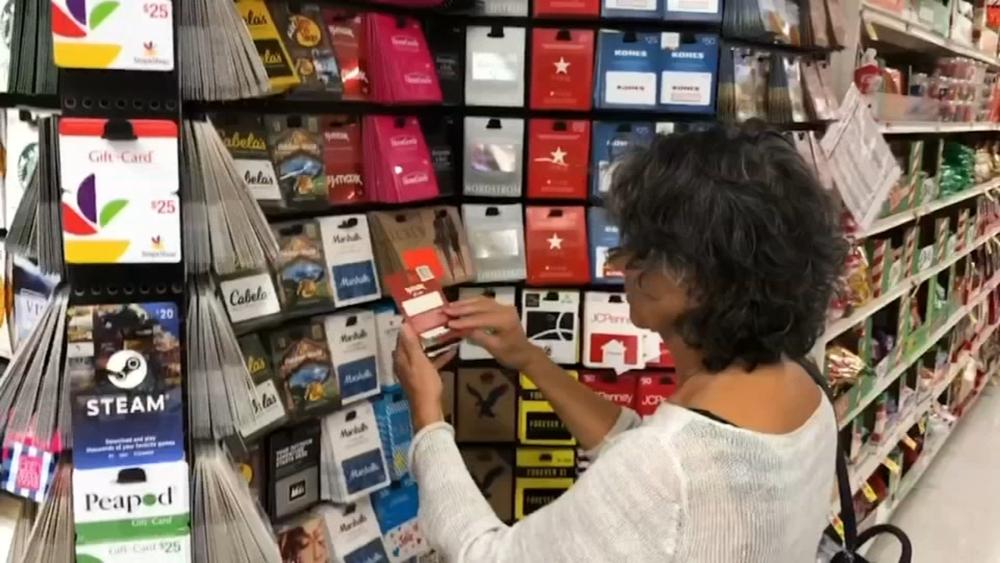
Buying a prepaid or gift card from a store rack feels like one of the simplest payment transactions possible. You choose a card, decide how much money to load, pay at the register and either use it yourself or give it to someone else. The physical card is still in your possession, so it seems reasonable to assume the balance is safe until somebody actually spends it.
A growing type of fraud exploits exactly that assumption. Known as gift card draining, it can begin before the legitimate customer has even purchased the card. Criminals obtain information from cards displayed in stores, return them to the rack and wait for an unsuspecting shopper to activate one. Once money is loaded, the stolen card details may be used to remove the balance before the real owner gets a chance to spend it.
Recent warnings in September 2026 have put the issue back in focus as retailers approach the busy holiday gift-card season. For consumers buying physical prepaid cards, the lesson is not to stop using them. It is to treat the package itself as something worth inspecting before reaching the checkout.
How Gift Card Draining Works
Traditional payment-card fraud often begins after someone has used a card. Details might be captured through phishing, a compromised website or a skimming device. Gift card draining can reverse that sequence. The criminal may target a card while it is still sitting unactivated in a retail display.
Exact methods vary, but the basic process can look like this:
- A fraudster obtains access to an unactivated card or its packaging.
- The card number, security information or other usable credentials are copied.
- The packaging is manipulated so that the card appears untouched.
- The card is returned to a retail display.
- A legitimate customer purchases it and loads money.
- The fraudster detects or repeatedly checks for activation.
- The balance is spent or transferred before the buyer or recipient uses it.
The unusual part is step five. The legitimate customer’s own purchase turns previously useless stolen information into something valuable. That explains why victims can be confused when a newly purchased card shows little or no available balance. They may never have shared the number, clicked a suspicious message or entered the card on an unfamiliar website.
Physical Packaging Has Become Part of Payment Security
Shoppers naturally pay attention to the card itself, but packaging now deserves the same scrutiny. Modern prepaid-card packaging is designed to conceal sensitive information. If somebody has opened, cut, resealed or otherwise manipulated that packaging, the card should not be purchased simply because it still looks acceptable from a distance.
Potential warning signs include:
| What to inspect | Possible warning sign |
|---|---|
| Outer packaging | Tears, cuts or unusual openings |
| Seals | Misalignment or evidence of resealing |
| Card position | Card appears shifted or incorrectly placed |
| Security areas | PIN or protected information looks exposed |
| Labels | Stickers covering original information |
| Surface | Scratches or signs of manipulation |
| Overall package | Anything inconsistent with nearby cards |
Not every imperfect package indicates fraud. Products can be damaged during transport or handling. The practical rule is simpler: when there is uncertainty, choose another card and alert store staff. There is little reason to take a questionable package when an untouched alternative is available.
Keep the Receipt After Buying the Card
Receipts are easy to discard, especially when the card itself feels like proof of purchase. In a fraud dispute, however, the receipt can become important evidence. It can establish where and when the card was purchased and how much money was loaded onto it. The FTC recommends keeping both the card and the store receipt when dealing with gift-card scams.
That is particularly useful when the card is intended as a gift. Imagine loading $100 onto a card and handing it to someone several weeks later. If the recipient discovers that the balance has disappeared, reconstructing the original transaction becomes harder when the packaging and receipt were thrown away immediately.
A better routine is to retain:
- the purchase receipt;
- activation documentation provided at checkout;
- the original card or packaging;
- photographs if anything unusual is discovered;
- records of attempted purchases or declined transactions.
Those records do not guarantee that funds will be recovered, but they make it considerably easier to explain what happened when contacting customer support or the retailer.
Check the Balance Rather Than Waiting Weeks
A prepaid card that will be used immediately creates a smaller window between activation and legitimate spending than one left untouched for months. That does not mean every card should be spent as quickly as possible. It does mean that checking the balance after purchase can identify a problem earlier.
For Vanilla Prepaid cards, consumers should use the official balance-checking channel rather than searching randomly for a website and entering card credentials into the first result that appears.
This distinction has become more important as fraudsters increasingly imitate legitimate payment and gift-card services online. In September 2026, Malwarebytes documented fake checkout sites appearing through search results for gift-card provider Bitrefill. Those sites copied legitimate branding while directing payments to criminals. Physical tampering and fake websites are different scams, but they rely on a similar weakness: consumers assume something that looks familiar is authentic.
Never Give Card Details to Someone Demanding Payment
Card draining should not be confused with another long-running gift-card scam. In an impersonation scam, the criminal contacts the victim and invents a reason that payment must be made using gift cards. They may pretend to represent a company, government department, employer, technical-support service or even someone the victim knows.
The victim is then instructed to purchase cards and send the numbers or PINs. The FTC’s guidance remains straightforward: a legitimate government agency or business will not unexpectedly demand that somebody buy gift cards and provide the numbers as payment.
This is worth remembering because the physical card never needs to leave your hand for the money to be stolen. Once usable credentials are provided to another person, they may be able to access the value remotely.
Urgency is another warning sign. Instructions such as “do this immediately,” “don’t tell anyone” or “stay on the phone while you buy the cards” are designed to prevent the victim from stopping to question the request.
Physical Cards and Digital Fraud Are Starting to Overlap
It is tempting to divide payment fraud into two categories: criminals either attack physical cards in stores or attack people online. In practice, the boundary is disappearing.
A criminal can manipulate a physical card and then use online systems to monitor its balance. Another can create a fake website that imitates a legitimate card provider. Phishing messages can direct victims toward convincing payment pages, while stolen card credentials can be traded digitally without the physical card ever changing hands again.
That creates a broader security chain:
Retail display → activation → balance management → online spending → customer support
A weakness at any stage can matter.
For consumers, this means payment security begins before checkout and continues after the card has been purchased.
What to Do If a Newly Purchased Card Has No Balance
Discovering an unexpectedly empty prepaid card does not automatically reveal why the money disappeared. There may be a transaction issue, an activation problem or unauthorized use. The first step should therefore be checking the card through the issuer’s official channel and reviewing available transaction information. If the funds appear to have been used without authorization, contact the card issuer promptly. Keep the physical card and receipt rather than throwing them away.
A useful response sequence is:
- Check the balance through the official website or support channel.
- Review transactions if transaction history is available.
- Keep the card, packaging and receipt.
- Contact the card issuer and report the suspected unauthorized activity.
- Contact the retailer if physical tampering may have occurred.
- Document dates, amounts and support case numbers.
- Report suspected scams to the appropriate consumer-protection authority.
Speed matters because unauthorized funds can be moved quickly. Waiting several weeks before reporting the problem may make investigating what happened more difficult.
Retailers Are Also Changing Their Approach
Gift-card fraud is not solely a consumer problem. Retailers and card manufacturers are under increasing pressure to make products harder to manipulate before sale. Recent regulatory attention in the United States has focused on prepaid-card fraud and the rules surrounding gift-card products, with requirements differing between states.
Potential countermeasures include more secure packaging, improved activation controls, employee training, restrictions on suspicious transactions and better systems for detecting unusual balance activity.
Retail placement can matter too. Cards positioned in heavily monitored areas or behind service counters are harder to manipulate unnoticed than products sitting in an isolated display. No single measure removes the problem entirely, which is why security increasingly depends on several layers rather than one tamper-resistant sticker.
A 20-Second Inspection Can Prevent a Much Bigger Problem
Prepaid cards remain useful precisely because they are simple. They can be purchased without opening a traditional bank account, used for controlled spending and given to someone without having to predict exactly what that person wants to buy. That convenience does not need to disappear because criminals have found ways to exploit retail displays.
Instead, the purchasing habit needs a small update. Before paying, inspect the package. Avoid anything that appears opened or resealed. Keep the receipt after activation, use official websites when checking card information and never send card numbers or PINs to someone who unexpectedly demands payment.
Those steps take considerably less time than trying to understand why a card that was supposed to contain money is suddenly empty. Gift card draining works partly because shoppers have historically had little reason to examine an unactivated card closely. In 2026, that assumption is becoming outdated. The safest moment to spot a compromised prepaid card may now be before it ever reaches the checkout.