
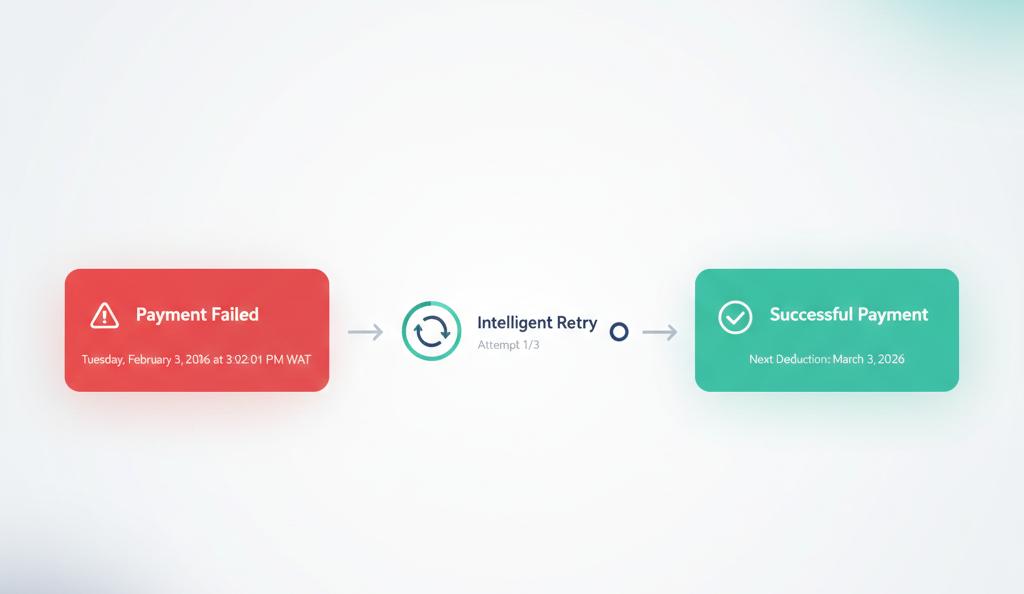
A failed card payment does not always mean the customer has no money or wants to cancel a service. Transactions can fail because of temporary issuer problems, expired credentials, spending limits, network interruptions or timing issues. For online businesses that depend on recurring or digital payments, treating every failed attempt as a final rejection can create unnecessary churn and lost revenue.
This is why payment retry systems are becoming more sophisticated. Instead of immediately trying the same transaction again or simply asking the customer to re-enter their card details, modern payment infrastructure can decide when, how and whether another attempt should be made. The goal is not to force transactions through, but to distinguish between failures that may resolve naturally and those that require customer action.
Not all declined payments mean the same thing
A payment decline is often presented to the user as a simple failure, but the underlying reason can vary significantly. Some declines are permanent. A closed account or an invalid card number is unlikely to succeed if retried unchanged. Other failures are temporary. A bank may reject a payment because the account has insufficient funds at that moment, because the issuer’s systems are unavailable or because a transaction triggered a short-term security check.
A useful retry system therefore begins with classification.
| Failure Type | Typical Retry Value |
|---|---|
| Temporary issuer error | Often worth retrying |
| Insufficient funds | May succeed later |
| Expired card | Usually requires updated details |
| Invalid card number | Retry unlikely to help |
| Network timeout | Often worth retrying |
| Suspected fraud | Usually requires additional action |
| Spending limit reached | May depend on timing or user action |
The key difference is that failed payments are no longer treated as one uniform category.
Timing can matter as much as the payment method
A common mistake in basic payment systems is retrying too quickly. If a transaction fails because of insufficient funds, sending the same request again several seconds later is unlikely to change the result. A retry several hours or days later may have a better chance, especially for recurring payments that coincide with salary deposits or account replenishment.
This is where intelligent retry scheduling becomes useful. Instead of using one rigid retry pattern for every customer, platforms can adapt the timing based on the type of decline, historical payment behaviour and the nature of the service.
For example, a subscription business might use different retry intervals for:
- temporary technical failures;
- insufficient funds;
- expired credentials;
- recurring card verification issues;
- issuer authentication problems.
The system becomes more selective rather than simply more persistent.
Recurring payments benefit the most
Subscription businesses are particularly sensitive to failed payments because one decline can interrupt an otherwise healthy customer relationship. A streaming platform, software provider or digital membership service may have a customer who has paid successfully for months. If one scheduled payment fails because of a short-term issue, cancelling access immediately may create unnecessary friction.
Smart retry logic gives the service a chance to recover the payment before the customer even notices a problem. This can reduce involuntary churn, which occurs when a customer loses access because a payment failed rather than because they intentionally cancelled. The distinction matters. A person who chooses to leave and a person whose card was temporarily declined are not the same type of customer.
Retry systems can use previous payment behaviour
Historical information can make retries more effective. If a particular account tends to receive funds at predictable times, or if previous failed transactions have succeeded after a certain interval, the system can use that pattern to choose a better retry window. That does not require guessing a customer’s finances in detail. Even simple behavioural signals can improve timing.
A platform might consider:
- whether the customer has paid successfully before;
- how often previous payments failed;
- which decline reason was returned;
- when similar transactions later succeeded;
- whether the card has recently been updated.
The purpose is to avoid unnecessary retries while increasing the probability that the next attempt occurs under better conditions.
Retry logic can reduce payment noise
Repeated failed attempts are not just frustrating for users. They can also create operational noise for merchants and payment processors. If a system retries indiscriminately, it may generate multiple declines for the same underlying problem. That can lead to unnecessary transaction traffic, customer notifications and support requests. More selective retry logic reduces this noise.
Instead of attempting the same transaction five times in a short period, the system can wait, assess the failure category and choose a more appropriate moment. In some cases, it may decide not to retry at all and instead request updated payment details. This creates a cleaner payment flow for both businesses and customers.
Automatic retries should remain invisible when possible
The best payment recovery experience is often one the customer barely notices. If a temporary network failure occurs and the retry succeeds a short time later, there may be no reason to interrupt the user. The platform can complete the payment quietly and continue the service normally.
However, not every failure should remain hidden. If the problem requires customer action, such as an expired card or blocked payment method, the user needs a clear explanation. This creates two broad paths:
| Payment Issue | Best User Experience |
|---|---|
| Temporary technical failure | Retry quietly |
| Short-term insufficient funds | Retry later, then notify if needed |
| Expired card | Ask for updated details |
| Authentication required | Prompt user to complete verification |
| Invalid payment method | Request replacement |
| Repeated decline | Stop retrying and communicate clearly |
Good retry design therefore depends on knowing when not to retry.
Too many retries can create trust problems
Automation can easily become aggressive if it is not carefully controlled. A user who sees repeated payment attempts over several days may feel that the service is trying to take money without sufficient transparency. This is especially sensitive for subscription services, where customers may already be uncertain about billing dates or cancellation rules.
Retry systems need clear limits.
Businesses should define:
- how many retry attempts are reasonable;
- how long the retry period should last;
- when the customer should be informed;
- when access should be paused;
- when the payment method should be considered unusable.
The goal is recovery, not endless persistence.
Better messaging can improve recovery rates
When customer action is necessary, wording matters. A generic message such as “Payment failed” provides very little guidance. It tells the user what happened but not what to do next.
A more useful message might explain that the card could not be charged and offer a clear next step, such as checking available funds, updating the payment method or completing authentication. Payment recovery works better when the retry system and communication layer operate together. Automation handles temporary problems, while clear messaging handles issues that require human input.
Prepaid cards create a special retry case
Prepaid cards introduce an interesting challenge because balances can change frequently. A user may have enough funds for a transaction one day and not the next. If a recurring service attempts a payment while the balance is too low, a later retry may succeed once the card has been topped up. This makes timing particularly important.
However, merchants cannot assume that every prepaid card decline will resolve automatically. The card may be inactive, expired or no longer used by the customer. Retry logic still needs to distinguish between temporary balance issues and more permanent failures. For prepaid payment environments, intelligent scheduling can therefore be more useful than simply increasing the number of attempts.
Payment retries are becoming more data-driven
Older retry systems often relied on fixed rules: retry after one day, then again after three days, then cancel. Modern payment infrastructure can be more flexible. A merchant may combine issuer response codes, transaction history, card status and customer behaviour to decide whether another attempt is worthwhile. The result is a more targeted approach that treats different payment failures differently.
A simple comparison shows the shift:
| Traditional Retry System | Smart Retry System |
|---|---|
| Fixed intervals | Adaptive timing |
| Same logic for all declines | Decline-specific logic |
| Limited context | Uses transaction history |
| Repeated attempts | Selective attempts |
| Generic failure messages | More relevant communication |
The difference is not just automation. It is better decision-making around automation.
Retry strategies can help reduce involuntary churn
One of the biggest business benefits is customer retention. If a payment failure immediately stops service, a customer may leave even though they never intended to cancel. Recovering the payment automatically can preserve the relationship without requiring the user to restart a subscription or contact support.
This is particularly valuable for low-friction digital services where customers expect billing to happen quietly in the background. At the same time, recovery systems should not be designed purely around merchant revenue. Customers benefit when payment problems are resolved with fewer interruptions, but only if the process remains transparent and respectful.
Failed payments are becoming a workflow, not an endpoint
Digital payments used to be treated in binary terms: approved or declined. That model is becoming less useful for recurring and online services. A decline can now trigger a sequence of decisions rather than a final stop. The platform can classify the failure, wait, retry, ask for updated details or escalate the issue depending on what happened. This turns payment recovery into a workflow.
The most effective systems do not retry everything. They retry only when the failure looks recoverable, at a time when success is more likely, and with clear communication when customer action is required. As online services become more dependent on recurring payments, that distinction will matter more. A smarter retry process can reduce unnecessary service interruptions, lower payment friction and make failed transactions less disruptive for both users and merchants.